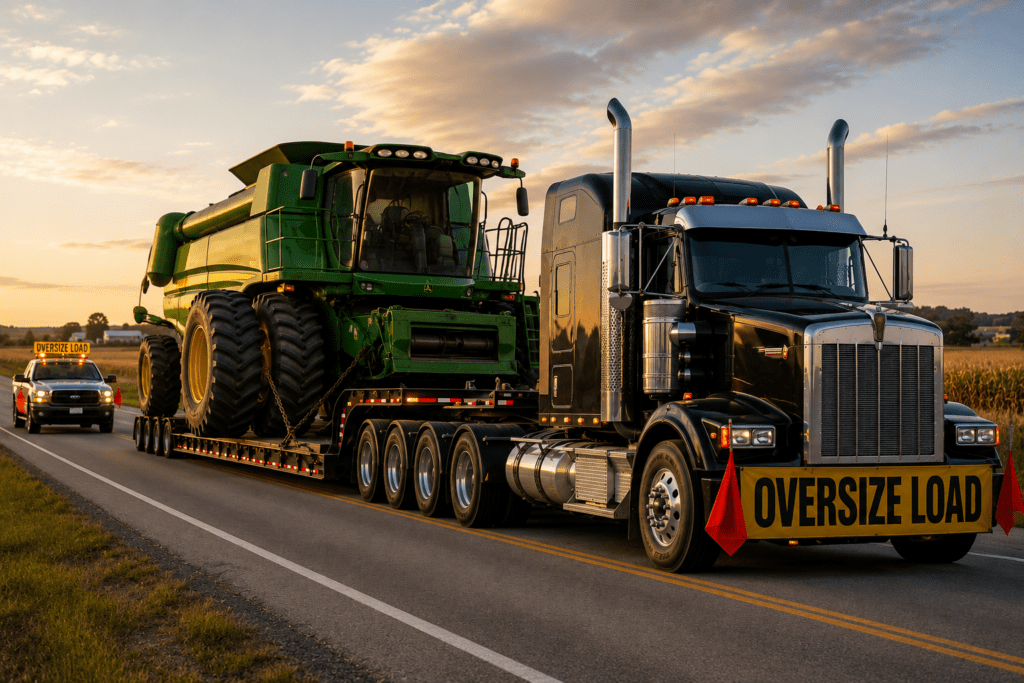

Moving oversized freight is far more complex than loading cargo onto a trailer and sending it down the highway. A single missing permit, incorrect weight declaration, or overlooked escort requirement can result in costly delays, fines, route changes, or even a shipment being stopped altogether.
That’s why understanding oversized load permits is critical for anyone shipping heavy equipment, industrial machinery, construction equipment, or other large freight.
Whether you’re moving cargo across town or across the Canada–U.S. border, here’s what every shipper should know about oversized load permits and heavy haul transportation.
What Is an Oversized Load?
An oversized load is any shipment that exceeds the legal dimensions or weight limits established by transportation authorities.
While regulations vary by jurisdiction, common legal limits include:
- Width: 8 ft 6 in (2.6 m)
- Height: 13 ft 6 in (4.1 m)
- Gross vehicle weight: 80,000 lbs (36,287 kg)
Once a shipment exceeds one or more of these limits, special permits may be required before transportation can begin.
Loads that exceed these limits are commonly classified as oversized loads or heavy haul shipments.
Common oversized and heavy haul freight includes:
- Construction equipment
- Excavators and bulldozers
- Agricultural machinery
- Industrial equipment
- Prefabricated building components
- Wind turbine components
- Generators and transformers
- Steel structures
Because these shipments can affect roadway safety and infrastructure, governments require additional oversight before they can be transported.
Why Are Oversized Load Permits Required?
Oversized load permits are government-issued authorizations that allow freight exceeding standard legal limits to travel on public roads.
These permits help transportation authorities manage:
- Roadway safety
- Traffic flow
- Bridge weight restrictions
- Infrastructure protection
- Utility clearances
- Construction zone restrictions
Additionally, permits may include specific requirements such as:
- Approved travel routes
- Restricted travel times
- Weather limitations
- Holiday restrictions
- Escort vehicle requirements
Without proper permits, carriers can face fines, shipment delays, or enforcement actions that prevent the load from continuing its journey.
Oversized load regulations vary by jurisdiction and may be subject to federal and state transportation requirements.
Who Obtains Oversized Load Permits?
One of the most common questions shippers ask is who is responsible for obtaining permits.
In most cases, the carrier arranges and secures the permits needed for transportation. However, successful permit applications depend heavily on accurate information provided by the shipper.
The Shipper’s Responsibilities
To obtain valid permits, carriers need accurate shipment information, including:
- Total weight
- Overall dimensions
- Center of gravity (when applicable)
- Loading specifications
- Packaging or crating details
- Exact addresses
Even small measurement errors can impact permit requirements, route approvals, or escort vehicle needs.
Therefore, providing accurate information from the beginning is one of the most important responsibilities a shipper has.
The Carrier’s Responsibilities
Once cargo information has been verified, the carrier typically handles:
- Permit applications
- Route planning
- Regulatory compliance
- Escort coordination
- Transportation scheduling
Furthermore, carriers must ensure permits remain valid for the approved route and travel dates.
What Do Escort Vehicles and Pilot Cars Do?
Many oversized loads require freight escort vehicles, commonly known as pilot cars.
Escort vehicles help ensure oversized freight travels safely through public roadways while complying with permit requirements.
Escort vehicle responsibilities often include:
- Warning approaching motorists
- Monitoring traffic conditions
- Assisting with lane positioning
- Helping navigate intersections and turns
- Identifying overhead clearance concerns
- Communicating directly with truck drivers
Depending on the size of the shipment and local regulations, a load may require one escort vehicle, police escorts, multiple escorts, or escorts positioned both in front of and behind the truck.
Because escort requirements vary by province and state, permit planning becomes an essential part of the transportation process.
Common Permit Mistakes That Cause Delays
Even experienced shippers can unintentionally create permit issues that delay transportation.
Some of the most common problems include:
- Incorrect cargo dimensions
- Inaccurate weight declarations
- Last-minute shipment changes
- Improper axle weight distribution
- Missing route approvals
- Failure to account for load overhang
For example, a shipment that is only a few inches wider than originally reported may require a completely different permit, additional escort vehicles, or a new route approval.
As a result, even minor errors can create major transportation delays.
Why Route Planning Is So Important
Transporting oversized freight is not simply a matter of selecting the shortest route.
Instead, carriers must evaluate:
- Bridge clearances
- Weight restrictions
- Utility lines
- Construction zones
- Road width limitations
- Tight turns and intersections
In many cases, the most direct route may not be a legal route.
Consequently, proper route planning helps prevent delays, safety issues, and costly permit violations.
How Much Do Oversized Load Permits Cost?
Permit costs vary depending on several factors, including:
- Shipment dimensions
- Total weight
- Route length
- Number of jurisdictions involved
- Escort vehicle requirements
- Special route surveys
While some permits may be relatively inexpensive, more complex heavy haul shipments involving multiple states, provinces, or escort vehicles can significantly increase transportation costs.
Working with an experienced carrier can help identify permit requirements early and avoid unexpected expenses later in the process.
Cross-Border Oversized Load Permits
Cross-border oversized freight presents additional challenges because permit requirements often change between jurisdictions.
A shipment traveling between Canada and the United States may require separate permits for:
- Provinces
- States
- Municipalities
- Special transportation corridors
Furthermore, carriers must comply with applicable transportation regulations in both countries.
Escort vehicle requirements, travel restrictions, and allowable dimensions can also vary significantly from one jurisdiction to another.
Because of these differences, cross-border oversized shipments require careful coordination and advanced planning to avoid delays at border crossings and throughout transit.
Why Proper Permitting Matters
Obtaining the correct permits is about much more than regulatory compliance.
Proper permitting helps:
- Protect public safety
- Prevent transportation delays
- Reduce the risk of fines
- Avoid route disruptions
- Protect infrastructure
- Improve overall shipment efficiency
Additionally, proper permit planning helps prevent costly surprises that can arise when oversized freight encounters restrictions during transit.
Frequently Asked Questions About Oversized Load Permits
Who is responsible for obtaining oversized load permits?
In most cases, the carrier obtains oversized load permits. However, the shipper must provide accurate dimensions, weights, and shipment details to ensure permits are issued correctly.
When are escort vehicles required?
Escort vehicle requirements vary by jurisdiction and depend on the size, weight, and route of the shipment. Larger oversized loads may require one or more pilot cars.
Can oversized loads travel at night?
Some jurisdictions allow nighttime travel, while others restrict oversized loads to daylight hours. Permit conditions determine when transportation is allowed.
How long does it take to obtain an oversized load permit?
Permit timelines vary by jurisdiction. Some permits can be issued within hours, while others may require several days of review.
What happens if a load exceeds permit dimensions?
The shipment may require additional permits, escort vehicles, route changes, or special approvals before transportation can continue.
How Titan Transline Helps Simplify Oversized Shipping
Successfully transporting oversized freight requires experience, planning, and attention to detail.
At Titan Transline, we work closely with customers to coordinate every aspect of oversized and heavy haul transportation, including permit requirements, route planning, escort vehicle coordination, and regulatory compliance.
Our team understands the complexities involved in moving oversized freight throughout Canada and the United States, helping customers avoid delays while ensuring shipments move safely and efficiently.
Whether you’re transporting construction equipment, industrial machinery, agricultural equipment, or other oversized cargo, proper planning makes all the difference.
If you’re planning an oversized shipment, contact our logistics team to discuss permit requirements, escort vehicles, route planning, and transportation options.
When oversized freight is handled correctly from the beginning, permits, escorts, and transportation logistics work together to keep your shipment moving safely from origin to destination.